How Much Does a Shopify Store Cost? Real Prices, ROI & Hidden Costs for B2B
Search "how much does a Shopify store cost" and you will find answers ranging from "$29 per month" to unhelpfully vague "it depends" statements. For CTOs and Founders making a strategic platform decision, both extremes are functionally useless.
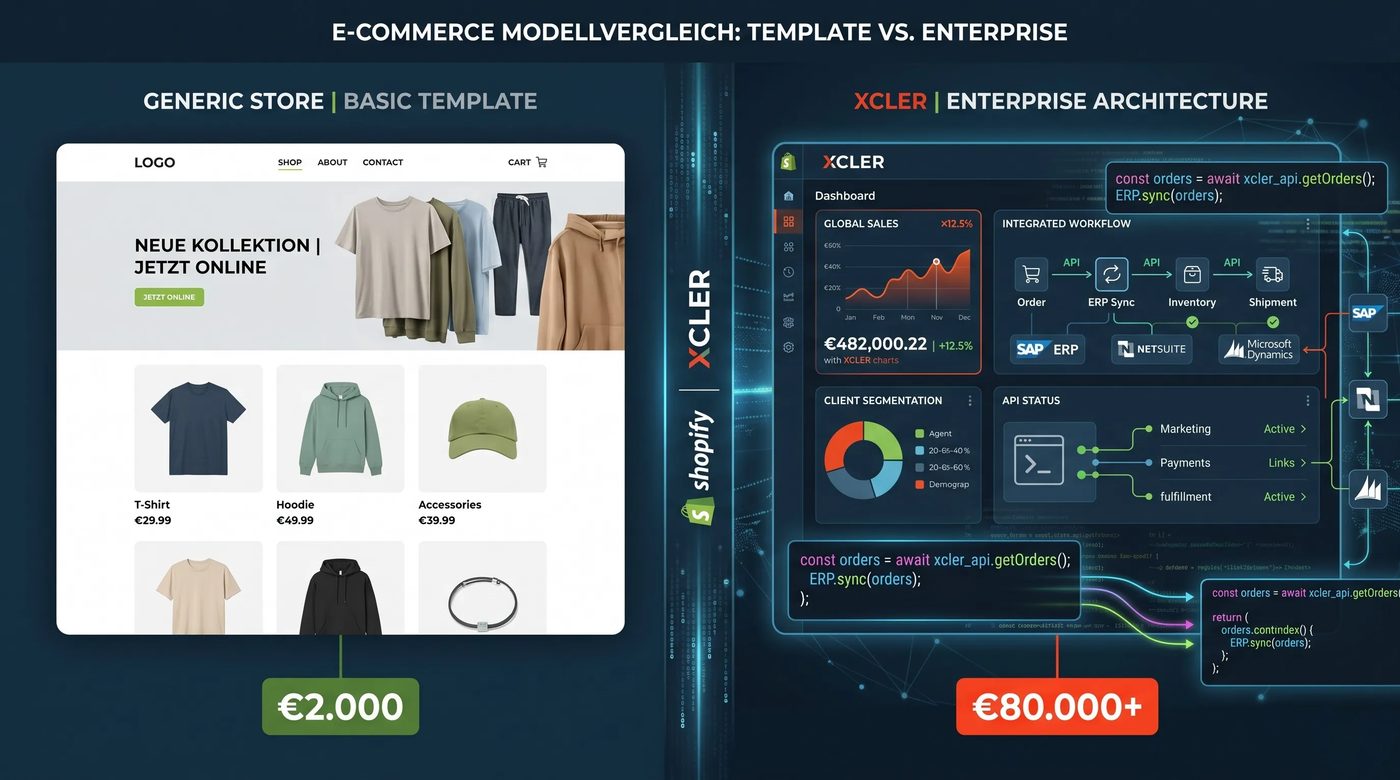
Here is the honest answer: having a Shopify store built professionally costs between €2,000 and €80,000+ — and that range is not arbitrary. It is the direct consequence of architectural decisions made in the first weeks of a project, decisions that will define your technical capabilities and operational constraints for the next three to five years.
This is not a beginner's guide to setting up a Shopify trial account. This is a frank analysis written for technical decision-makers who need to understand why a properly architected e-commerce foundation commands a serious investment — and what that investment actually returns. We will expose the hidden long-term costs embedded in cheap freelancer templates and contrast them with the measurable, compounding ROI of a custom, systems-architected Shopify implementation built for B2B scale.
Whether you are evaluating a first Shopify build, auditing a legacy store that has stopped scaling, or comparing the total cost of ownership between platform options, this breakdown will give you the technical and financial clarity to make the right call.
Standard vs. Enterprise E-Commerce: What You Actually Get
The most expensive mistake we encounter during technical audits of incoming clients is not overspending. It is under-investing in architecture early, then overpaying to fix it later.
A company spends €4,000–€6,000 to have a Shopify store built. Eighteen months later, the system cannot integrate with their ERP, cannot handle their product catalog complexity, cannot support B2B customer group pricing, and every meaningful modification requires a developer to reverse-engineer a theme they did not write. The cost of that rectification — replatforming, data migration, rebuilt integrations — routinely exceeds the original investment by a factor of three or four.
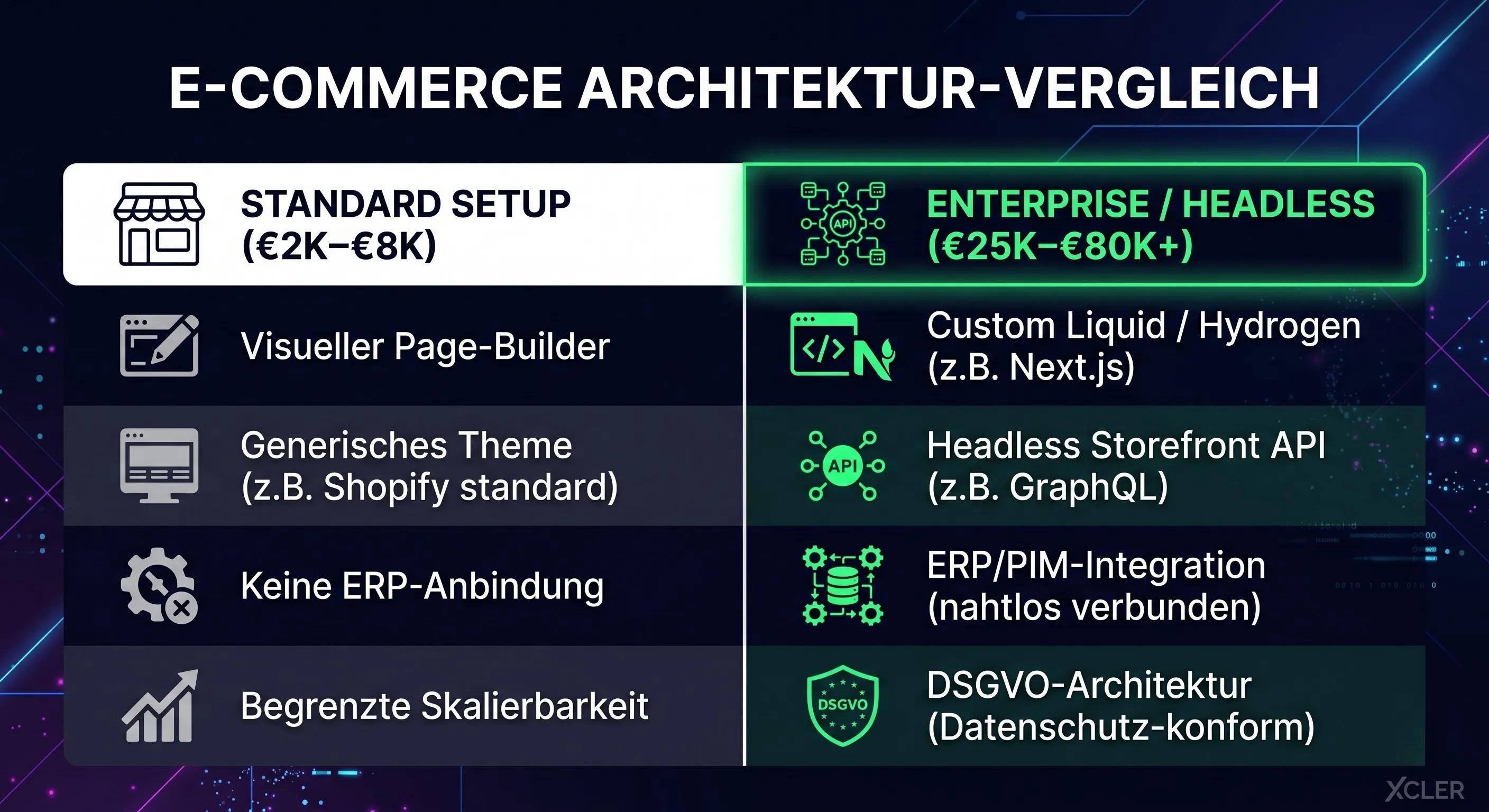
The standard setup (€2,000–€8,000) is typically built on a purchased or lightly modified premium theme, assembled with a page builder such as Shogun or PageFly. Development takes two to four weeks, looks presentable at launch, and fulfills basic transactional requirements. The structural problems surface later. Page builders generate bloated, heavy render code that systematically undermines Core Web Vitals scores. Off-the-shelf themes are designed for generic use cases — not for your specific B2B catalog structures, customer account hierarchies, or procurement workflows. The moment you need to connect an ERP system, a PIM, or a logistics platform, you are working against an architecture that was never designed to support those requirements.
The enterprise setup (€25,000–€80,000+) follows fundamentally different logic. Before a single line of code is written, a systems architecture review defines the data flows, integration touchpoints, customer journey requirements and scalability parameters of the entire platform. The questions are not "which theme do we like?" — they are: what systems need to communicate with this store? How do B2B customer groups behave differently from B2C? How does the infrastructure perform under peak load? What does the codebase need to look like for a team to maintain it in four years?
At this level, two primary architectural patterns dominate. Custom Liquid Theme Engineering — built entirely from scratch without page-builder overhead — delivers a lean, semantically precise codebase tuned to your exact product data structure. Headless Commerce with the Shopify Storefront API decouples the frontend entirely, running it as an independent Next.js or Nuxt application while Shopify operates as the commerce engine behind it. Headless is particularly appropriate for companies with complex personalization requirements, multilingual storefronts, or deep PIM integrations with systems like Akeneo, inRiver or Contentful.
The decision to build a Shopify store at enterprise level is not about prestige. It is a total cost of ownership calculation across three to five years — and at that timescale, the economics consistently favor investing correctly at the beginning.
The 4 Cost Drivers of Professional Shopify Store Development
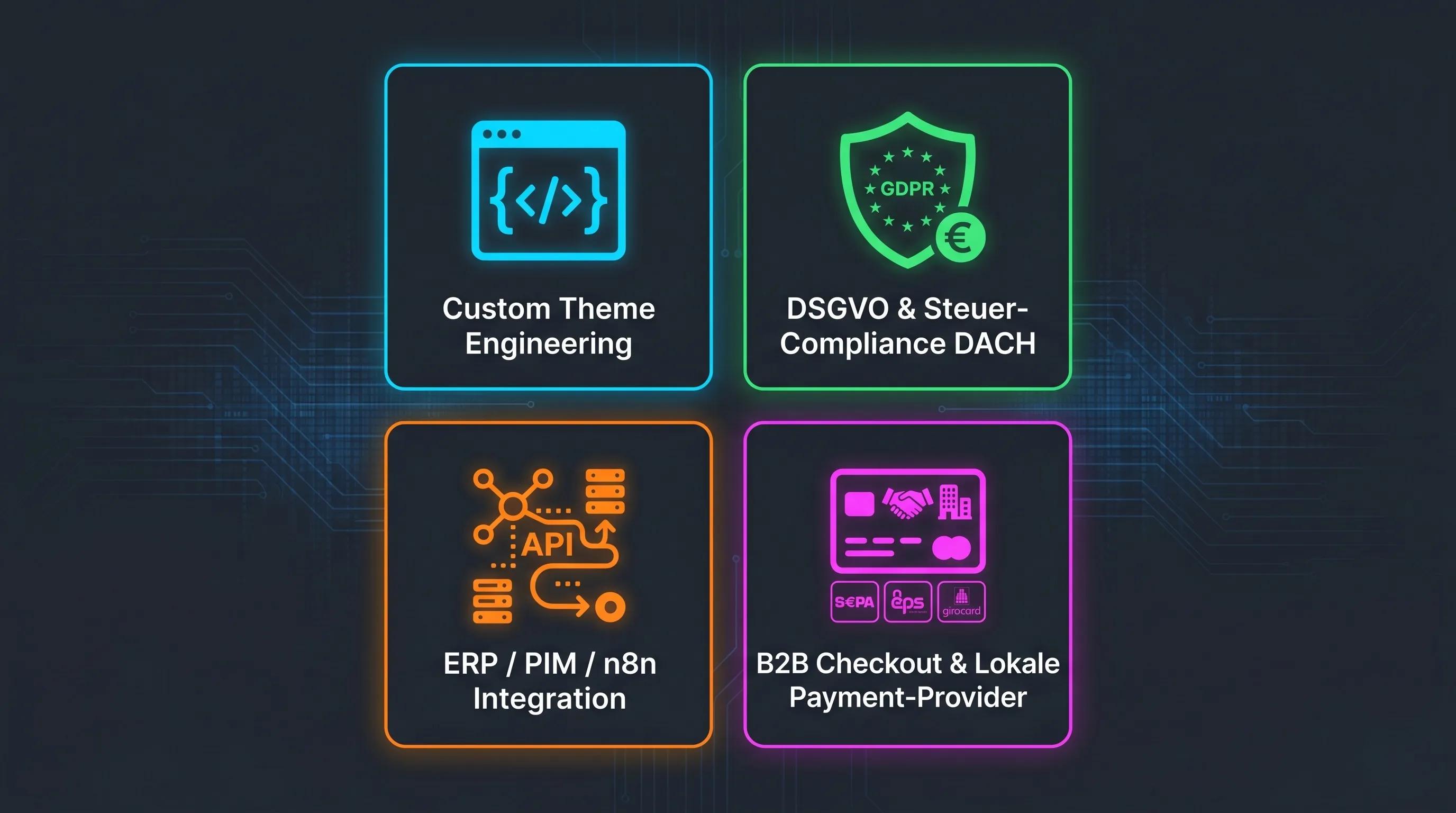
When clients ask why Shopify store setup costs vary so dramatically between agencies and freelancers, the answer lies in four technical dimensions that define both the actual development effort and the long-term value of the implementation.
1. Custom Theme Engineering: No Page Builders, No Compromises
The largest invisible cost driver in the budget segment is not what gets paid — it is what gets cut to keep the price low. Page builders and pre-configured themes are development shortcuts that reduce initial build time while accumulating technical debt that compounds over time.
Professional custom theme engineering means clean, semantically correct Liquid templating that is precisely mapped to your product data architecture. No bloated CSS frameworks designed for generic grid layouts. No JavaScript overhead from builder render pipelines. The output is a codebase that loads in under two seconds, achieves Largest Contentful Paint scores that Google rewards, and remains maintainable by any competent development team without an archaeology expedition into someone else's undocumented customizations.
The Shopify store development cost for custom theme engineering alone ranges from €8,000 to €25,000 depending on catalog complexity, number of templates, and custom component requirements. That is not a design agency fee. That is systems engineering — and it is what separates a store that scales from one that stagnates.
When you hire someone to build a Shopify store using page builders, you are not buying a cheaper version of the same product. You are buying a fundamentally different — and structurally weaker — product at a lower upfront price.
2. GDPR & Tax Compliance for the DACH Market
For any business operating in Germany, Austria or Switzerland — or selling to customers in these markets — compliance architecture is not optional configuration. It is a foundational layer that must be designed into the system from day one.
In the DACH context, this means server-side consent management (not a client-side Google Tag Manager workaround), legally sound data processing agreements with every integrated third-party service, correct payment provider data flows under GDPR Article 28, tax-correct configuration for B2B transactions including the reverse-charge mechanism for EU cross-border sales, OSS-compliant VAT treatment across the EU, and invoice generation processes conformant with §14 UStG.
These are not bolt-on features. Retrofitting proper compliance architecture onto a system not designed for it is disproportionately expensive — and the alternative is exposure to GDPR fines under Article 83, which scale to 4% of global annual turnover. In our experience, DACH-compliant architecture accounts for €3,000 to €12,000 of a professional project budget. Compared to the risk exposure it eliminates, it is unambiguously one of the highest-ROI line items in the entire project.
Any agency quoting you a Shopify store setup cost that does not explicitly include compliance architecture for your target market is either not planning to deliver it or does not know it is required.
3. API Integrations: ERP, PIM, n8n / Make.com
For businesses beyond early-stage, a Shopify store is not a standalone system. It is a node in an ecosystem of inventory management, product data, logistics, finance and customer relationship systems. Integrating these systems is technically the most demanding — and therefore the most expensive — component of any serious Shopify project.
Typical integration scenarios in our B2B engagements:
- ERP Integration (SAP, Microsoft Dynamics, Sage, Odoo): Bidirectional synchronization of inventory levels, customer-specific pricing, account data and order status via REST or GraphQL APIs. Scope: €5,000–€20,000 depending on ERP complexity and data model alignment.
- PIM Integration (Akeneo, Contentful, inRiver): Automated product data feed with attribute mapping, image transformation pipelines, and category hierarchy synchronization. Scope: €4,000–€15,000 depending on catalog size and attribute complexity.
- Automation Layer via n8n or Make.com: Workflow automation for order notifications, fulfillment triggers, returns processing and CRM synchronization — architected without vendor lock-in to proprietary iPaaS pricing models.
- Custom Webhook Architecture: Event-driven data flows that keep all systems in sync in real time, with error handling, retry logic and monitoring built in from the start.
A client comparing a €5,000 Shopify store quote against a €40,000 enterprise proposal and seeing a price difference without understanding the integration delta is not comparing the same deliverable. One is a storefront. The other is a commerce platform. The distinction has significant operational and revenue implications from day one of operation.
4. B2B Checkout & Local Payment Providers
Shopify's native checkout is optimized for B2C commerce. Adapting it for genuine B2B requirements — tiered pricing by customer group, purchase order workflows, invoice payment via Klarna B2B or Billie, corporate account structures with spend limits, tax-exempt EU transactions, multi-user account management — requires substantive development using Shopify Functions and the Checkout Extensibility API.
These are powerful capabilities. But they require engineers who understand Shopify's platform architecture at depth, not developers who configure settings in the admin panel. The Checkout Extensibility API, which fully replaces legacy checkout customization from 2025 onward, introduces a new paradigm for checkout logic that demands real platform expertise to implement correctly.
Beyond checkout logic, local payment method coverage is a conversion prerequisite in European markets. In Germany specifically, the absence of SOFORT, giropay, Klarna, and PayPal at checkout is one of the most consistently measurable drivers of cart abandonment. For Austrian and Swiss markets, analogous local provider requirements apply. Configuring, testing and legally integrating this payment stack costs €2,000–€8,000 depending on whether standard app integrations suffice or custom Checkout Extensions are required.
This is the cost driver most frequently omitted from budget-tier proposals — and the one whose absence most directly impacts post-launch revenue.
The XCLER Process: Systems Architecture Before Code
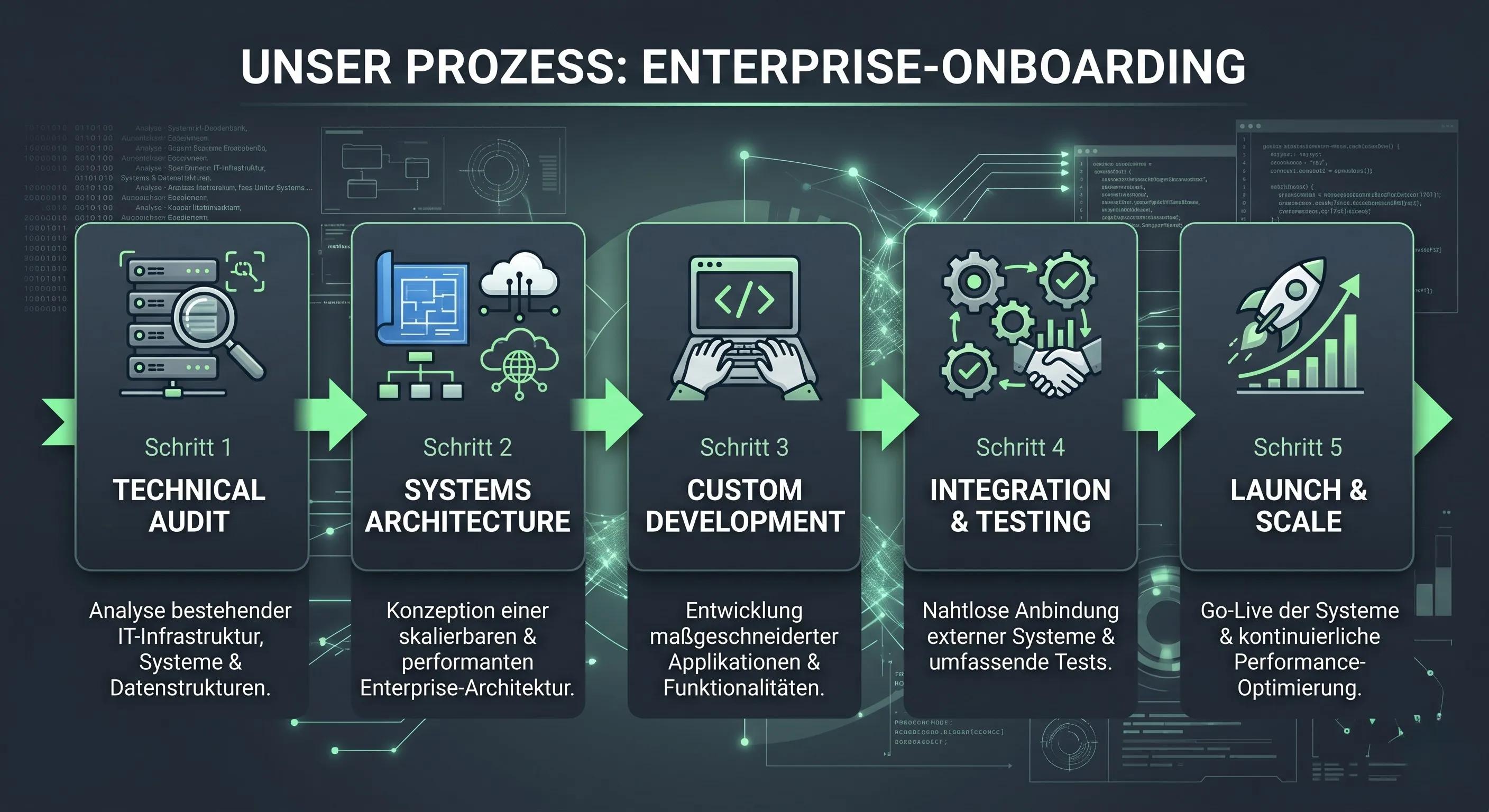
At XCLER, no Shopify project begins with design mockups or theme selection. Every engagement begins with a Technical Audit — a structured analysis of your existing system landscape, current data flows, integration requirements and growth objectives for the next 24 months.
The output of that audit is not a quote with hourly rates and vague deliverable descriptions. It is a Systems Architecture Blueprint: a documented decision framework that specifies which architecture — standard Liquid, custom theme, or headless Storefront API — is appropriate for your specific context, which integrations need to be built in which sequence, what the realistic cost breakdown looks like per phase, and which technical risks exist before they become budget surprises.
This approach is the structural reason why our implementations do not end in expensive remediation projects six months after launch. We build Shopify architectures that scale with your business — technically clean, GDPR-compliant, API-ready, and on a codebase that any competent development team can take ownership of in the future.
Our process follows a defined sequence: Technical Audit → Systems Architecture → Custom Development → Integration & Testing → Launch & Scale — with clear milestones, transparent per-phase costs, and a defined scope that structurally prevents budget escalation from undefined requirements.
When you engage XCLER to build a Shopify store professionally, you are not buying a template with your logo on it. You are buying an engineered commerce platform with a documented architecture, a clean integration layer, and a technical foundation that compounds in value as your business grows.
Ready for an Obligation-Free Technical Audit?
The question "how much does a Shopify store cost?" is the wrong entry point for a strategic platform decision. The right question is: what does a Shopify store cost you if the architecture fails to scale eighteen months after launch?
If you are ready to have a Shopify store built professionally — with an architecture that integrates, scales and converts — the logical first step is not a price list. It is a conversation about your technical requirements, your system landscape and your growth trajectory.
Visit our Shopify Service Hub and request an obligation-free Technical Audit. In a focused 45-minute session, we analyze your existing infrastructure, define the architecturally correct approach for your project, and give you an honest, defensible cost estimate grounded in your actual requirements — not a template price designed to win the initial conversation and expand scope later.
The difference between a €5,000 Shopify store and an €80,000 Shopify platform is not markup. It is architecture. Let us show you exactly where that investment goes — and what it returns.

This article is part of our content series on professional Shopify store development — covering processes, pricing and best practices for B2B e-commerce in the DACH region and beyond.