What Does a Shopify Agency Cost? (Pricing, ROI & Hidden Costs 2026)
Introduction: The Uncomfortable Truth Behind Shopify Agency Costs
Search for "Shopify agency costs" and you will encounter a vast spectrum. Proposals start at €1,500 and reach well beyond the €100,000 mark. This price range is not arbitrary — it is the direct result of fundamental differences in architecture, technical depth, and long-term scalability.
Most pricing comparisons you find online are written for freelancers and entry-level agencies. This article is not.
If you are a Founder or CTO building an eCommerce channel with serious growth ambitions — one that does not collapse under load, operates in full GDPR compliance, and integrates seamlessly with existing ERP, PIM, and automation systems — then you need to understand what Shopify development at enterprise level actually costs and why.
As a specialised technical team focused on scalable systems architecture, we work with clients across the entire DACH region. Our approach is not a web design service — it is precise, deliberate systems architecture that grows with your business.
This guide explains what the price differences actually mean — and why the cheapest option is often the most expensive decision of your career.
Standard vs. Enterprise eCommerce: What the Price Difference Actually Means
The Standard Setup: Cheap to Start, Expensive to Run
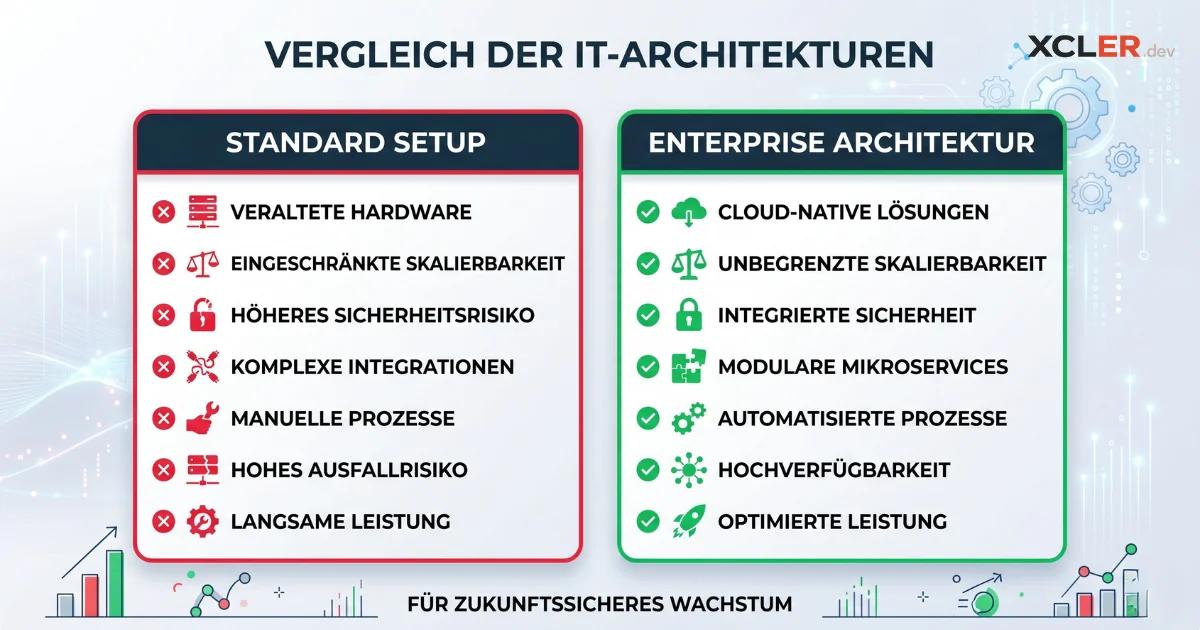
A typical Shopify store built on a purchased premium theme costs between €1,500 and €6,000. For a simple direct-to-consumer shop with a manageable product catalogue, this can work in the short term.
The problems begin the moment your business starts to grow:
- Template limitations force you into an ever-expanding stack of app integrations. Every app added increases load time, complexity, and monthly fixed costs
- Page builder code from tools like Pagefly or Shogun generates bloated HTML output that systematically degrades Core Web Vitals scores
- No clean API layer means every connection to an external system — ERP, inventory management, CRM — becomes an individual problem-solving exercise with unpredictable costs
- Vendor lock-in through proprietary theme structures makes later migrations or redesigns disproportionately expensive and time-consuming
The true cost of a standard setup does not appear at launch. It accumulates in operation — through performance degradation, manual processes, and the creeping impossibility of scaling without a complete rebuild.
The Enterprise Architecture: Higher Investment, Fundamental ROI Difference
A professionally developed custom Shopify architecture — particularly a headless setup with Next.js as the frontend and Shopify as the commerce backend — typically starts at €15,000 and extends to €80,000+ depending on complexity.
What you receive in return is fundamentally different:
- Complete decoupling of frontend and backend gives your development team maximum freedom in design, performance, and feature development — without Shopify's native constraints
- Server-side rendering and static generation via Next.js delivers PageSpeed scores of 95+ — which translates directly into better SEO rankings and lower bounce rates
- Clean API-first architecture makes integrations with SAP, Salesforce, Klaviyo, or bespoke internal systems a technically predictable and budgetable task
- Long-term maintainability through clean, documented code reduces dependency on individual developers and lowers maintenance costs consistently over time
The ROI difference is not abstract. It manifests in conversion rates, organic traffic growth, and the ability to enter new markets without commissioning a complete rebuild from scratch.
The 4 True Cost Drivers Behind Shopify Agency Pricing
What specifically determines where a Shopify project lands on the pricing scale? These are the four technical factors with the greatest influence:
1. Custom Theme Engineering vs. Page Builders
The difference between a hand-coded Shopify theme in Liquid and a page-builder-based store is the difference between a bespoke suit and off-the-rack clothing. One is built precisely for the body it serves. The other is a compromise by design.
Page Builders (Pagefly, Shogun, GemPages):
- Fast to set up, but the generated code is notoriously inefficient
- On average 40–60% more unused JavaScript than a custom-built theme
- PageSpeed scores of 45–65 on mobile are not the exception — they are the norm
- Every design change requires the original page builder — there is no exit without a complete redesign
Custom Theme Engineering:
- Development time: 120–300+ hours depending on complexity and feature requirements
- Complete control over every loaded asset — nothing unnecessary reaches the browser
- Lighthouse scores of 85–98 are achievable and reproducible across deployments
- A clean codebase that any qualified developer can understand, extend, and maintain
For serious eCommerce, custom theme engineering is not an optional premium add-on. It is the technical foundation upon which everything else is built.
2. GDPR-Compliant Tax and Invoice Setups
Within the German and European legal framework, the correct tax configuration of a Shopify store is not a standard deliverable — it is a technical challenge with direct legal consequences if handled incorrectly.
A professional GDPR-compliant Shopify configuration includes:
- Correct tax zone configuration for Germany, the EU, and third countries — including the OSS procedure for cross-border B2C trade within the European Union
- Automated, legally compliant invoice generation via third-party integrations such as Lexoffice, Sevdesk, or direct DATEV interfaces
- Cookie consent management with genuine conditional script loading — not merely a banner that appears but loads everything regardless
- Data processing agreements (DPA) documented and implemented with all relevant third-party service providers
- Privacy-compliant analytics — Matomo self-hosted or Plausible with EU server location as a fully compliant Google Analytics alternative
Each of these items requires technical implementation time that must be scoped and budgeted. Agencies that do not address these points explicitly are silently transferring the legal risk to you.
3. API Integrations for Automated Product Management
Manual product management is the silent killer of eCommerce profitability. Every hour your team spends manually updating stock levels, prices, and product data is an hour not invested in growth, marketing, or customer acquisition.
Modern Shopify architectures automate these processes entirely:
Make.com / n8n Automation Workflows:
- Automatic inventory synchronisation between Shopify and your warehouse management system (e.g., JTL, Sage, SAP)
- Price updates delivered via API webhooks without any manual intervention
- Automated order processing, shipping confirmations, and returns management
PIM System Connections:
- Structured product data from systems like Akeneo or Pimcore pushed directly into Shopify
- Consistent product descriptions and media assets maintained across all sales channels simultaneously
The development time for clean integration architecture typically runs 40–120 hours depending on system complexity. This is a one-time investment that pays back in reduced staff costs and eliminated error rates across months and years of operation.
4. Local Payment Providers and Shipping Options
A Shopify store that is not correctly configured for the German market loses customers at checkout — the most expensive point in the entire conversion funnel.
Payment Provider Integration for Germany:
- SEPA direct debit via Stripe or Shopify Payments correctly configured for German banking requirements
- Klarna as a complete buy-now-pay-later option with the correct German-market checkout flow
- PayPal configured with German tax and invoicing requirements applied
- Purchase on invoice for B2B transactions via specialist providers such as Mondu or Billie
Shipping Options for the DACH Market:
- DHL, DPD, Hermes, and GLS correctly configured as shipping options with automatic tracking information connected
- Shipping cost rules structured by weight, volume, and destination region
- Click-and-collect options for retailers operating physical store locations
This configuration sounds like standard work. It is not — when it is implemented correctly, completely, and in a way that does not create obstacles to future scaling.
Why a Shopify Agency in Germany is the Optimal Partner for DACH Projects

Choosing a Shopify agency in Germany is not a geographic preference — it is a strategic decision for technical precision and regulatory certainty.
A locally rooted team in the DACH region brings three decisive advantages:
Legal and Regulatory Expertise: GDPR, German tax law, Impressum requirements, AGB compliance — these are not peripheral concerns for us. They are daily practice. We know the current risk landscape for abmahnung actions and build compliance-first from day one of every project.
Communication Without Overhead: Timezone differences, language barriers, and cultural misunderstandings are not minor inconveniences in software development — they cost time, budget, and project momentum. Direct communication in your timezone, with complete understanding of your market context, is a measurable productivity advantage that compounds across a project's duration.
Network and Ecosystem Access: Local partnerships with German payment providers, logistics companies, legal advisors, and systems integrators enable connections that simply are not accessible to agencies operating from outside the DACH region.
Your Next Step: Request a Technical Audit

Shopify agency pricing is not a set of arbitrary numbers. It is the direct expression of the technical depth, architectural care, and long-term scalability that are built into a system from the very first line of code.
If you are building a business that will not be constrained by technical debt in two years — one that integrates seamlessly into your existing systems landscape, operates in full GDPR compliance, and remains stable under traffic spikes — then the right starting point is not another pricing comparison conversation.
It is a technical audit.
Our technical audit for Shopify projects analyses your current infrastructure, identifies concrete bottlenecks, and delivers an architectural roadmap — with clear priorities, realistic timelines, and fully transparent costs. No agency pitch. No vague promises. Only precise technical analysis.
Request Technical Audit → xcler.dev/services/shopify-development-germany